Funded Projects
BioWISE 2025
Description
The BioWISE 2025 Project is a scholarship and mentorship initiative designed to empower women in life science fields. It focuses on supporting 10 undergraduate and 15 postgraduate women in life sciences by providing mentorship, skill-building opportunities, and financial assistance. By fostering a supportive community, BioWISE helps participants navigate educational and career pathways in STEM, while raising awareness about gender disparities in scientific fields. The program combines interactive workshops mentorship sessions, and outreach activities, aiming to make STEM more accessible, engaging, and inclusive for women. It also highlights role models and success stories, demonstrating that women can thrive in science despite historical and societal barriers.
Impact Goals
- To increase women participation in STEM fields
- To address the increasing number of women leaving STEM courses and provide support to help them continue their studies.
- To connect the students with experienced scientists and to provide workshops to build research, communication and professional skills.
- To build a supportive community where women can collaborate and share experiences and support each other in scientific journey.
- To ensure women students have equal opportunities and visibility in STEM, contributing to a stronger and more inclusive scientific community.
Key organizations
- Biocon Biologics
- Biocon Foundation
- National Center for Biological Sciences (NCBS), Bengaluru
Funded by: Biocon Foundation
Contact: sreeparna.samanta@bestkc.in
Integrating Human and Animal Health With Surveillance and Disease Ecology in a Global Urban Center
Thematic area
Health and Wellness > One Health
Objectives
• Create a dynamic data dashboard on zoonoses
• Design a predictive tool to minimize outbreak risk
• Enable citizen and stakeholder engagement to allow participatory action
• Test evidence-based intervention in select wards in the city
Proposed Outcomes
• Governance: To ensure that a system is in place to govern, manage, coordinate and oversee all OneHealth activities in the city of Bengaluru. Such governance will serve as a model for other cities and regions.
• Capacity Building: To assess and strengthen the multi-disciplinary OneHealth core capacities required to prevent, detect, and respond to zoonotic diseases and mitigate their impact.
• Human Disease Surveillance: To enhance citywide coordinated surveillance, preparedness and response for prevention, detection, and control of zoonotic diseases.
• Environmental and Vector Surveillance: To identify circulating pathogens by metagenomic sequencing, to get a granular map of the pathogen landscape in the city.
• Disease Ecology: To provide information that can help design effective vector control strategies, and better understand zoonotic spillover dynamics.
• Model and Predict: To build predictive models to predict, pre-empt and minimize spillover events, make digital health maps available and suggest frameworks for OneHealth-based public health programs.
• Partnerships and Public Engagement: To establish a framework and raise awareness and motivation for monitoring, predicting, and responding to disease outbreaks for public health decisions in urban and peri-urban Bengaluru.
Impact Goals
• Integration of real-time surveillance and scientists in the field
• Involvement of local institutions
• Plan in place to mitigate outbreaks of prevalent diseases
• Social group and political groups involvement for implementation
• Citizen involvement
End beneficiaries Citizens through BBMP
Members
Project Leads:
• Prof. Farah Ishtiaq, TIGS
• Prof. Uma Ramakrishnan, NCBS
Other key members:
• Prof. Kavita Isvaran, IISc
• Dr. Shannon Olsson, The Echo Network
• Dr. Bhaskar, ARTPARK
• Dr. Taslimarif Saiyed, C-CAMP
• Mr. Ajay Raghavan, ICA
Partner Institutions
• AI & Robotics Technology Park (ARTPARK)
• Bangalore Sustainability Forum
• Bruhat Bengaluru Mahanagara Palike (BBMP)
• Centre for Cellular and Molecular Platforms (C-CAMP)
• Indian Institute of Science (IISc)
• Initiative for Climate Action (ICA)
• National Centre for Biological Sciences (NCBS)
• Tata Institute for Genetics and Society (TIGS)
• The Echo Network
Funded by: Office of PSA to GoI
Contact: sreeparna.samanta@bestkc.in
Precision Agriculture for Protected Farming
Thematic area
Urban Life > Precision Agriculture
Objectives
• Monitoring and regulation of microclimatic condition for protected farming
• Pest management in protected cultivation system
• Sensing, Imaging and Delivery Systems in Precision Agriculture
Proposed Outcomes
• Design and development of micro-climate-controlled polyhouse for roof-top and peri-urban agriculture
• Pest control: Air-sampler to monitor fungal spores, insect and pest loads in the polyhouse; Use of bio-derived insecticides, and pheromones to control pests in brinjal and tomato plants
• Precise and targeted pesticide delivery system
• Monitoring of plant status
• Design of a high impedance-based moisture sensor
• New sensor for rapid measurement of evapotranspiration
Impact Goals
Innovative products and solutions to improve urban and peri-urban agriculture with precision delivery of water, nutrients, and pesticides in newly developed polyhouses for urban and peri-urban agriculture.
End beneficiaries
• Agritech companies: Seed companies, Drip irrigation companies, Manufacturers of hydroponics, aeroponics systems, Pest management companies
• Farmers: High value crops, Protected agriculture of high value vegetables, flowers and seeds, Virus-free potato tuber cultivators
• Agri startups: Drone based pesticide delivery, Agri-robots, Sensing of soil moisture and irrigation, AI & ML based imaging for detecting plant health status and disease
Members
Project Leads:
• Prof. M S Bobji, IISc
Other key members:
• Dr. Kesavan Subaharan, NBAIR
• Dr. Markandeya Gorantla, ATGC
• Prof. Jishnu Keshavan, IISc
• Prof. M S Sheshshayee, UAS
• Prof. Mohan Raju B, UAS
• Prof. Sreenivas K R, JNCASR
• Prof. Sushmita Dash, IISc
• Prof. Utpal Nath, IISc
• Dr. Laxman R H, IIHR
• Dr. Nagesh M, NBAIR
• Dr. Shankara S Hebbar, IIHR
• Prof. Eswaramoorthy M, JNCASR
Partner Institutions
• ATGC Biotech Limited
• ICAR-IIHR & NBRC, Bengaluru
• Indian Institute of Science
• Jawaharlal Nehru Centre for Advanced Scientific Research, Bangalore
• University of Agriculture Sciences, Bangalore
Funded by: Office of PSA to GoI
Contact: mrinal.sarma@bestkc.in
Digital Podiatry Kiosk
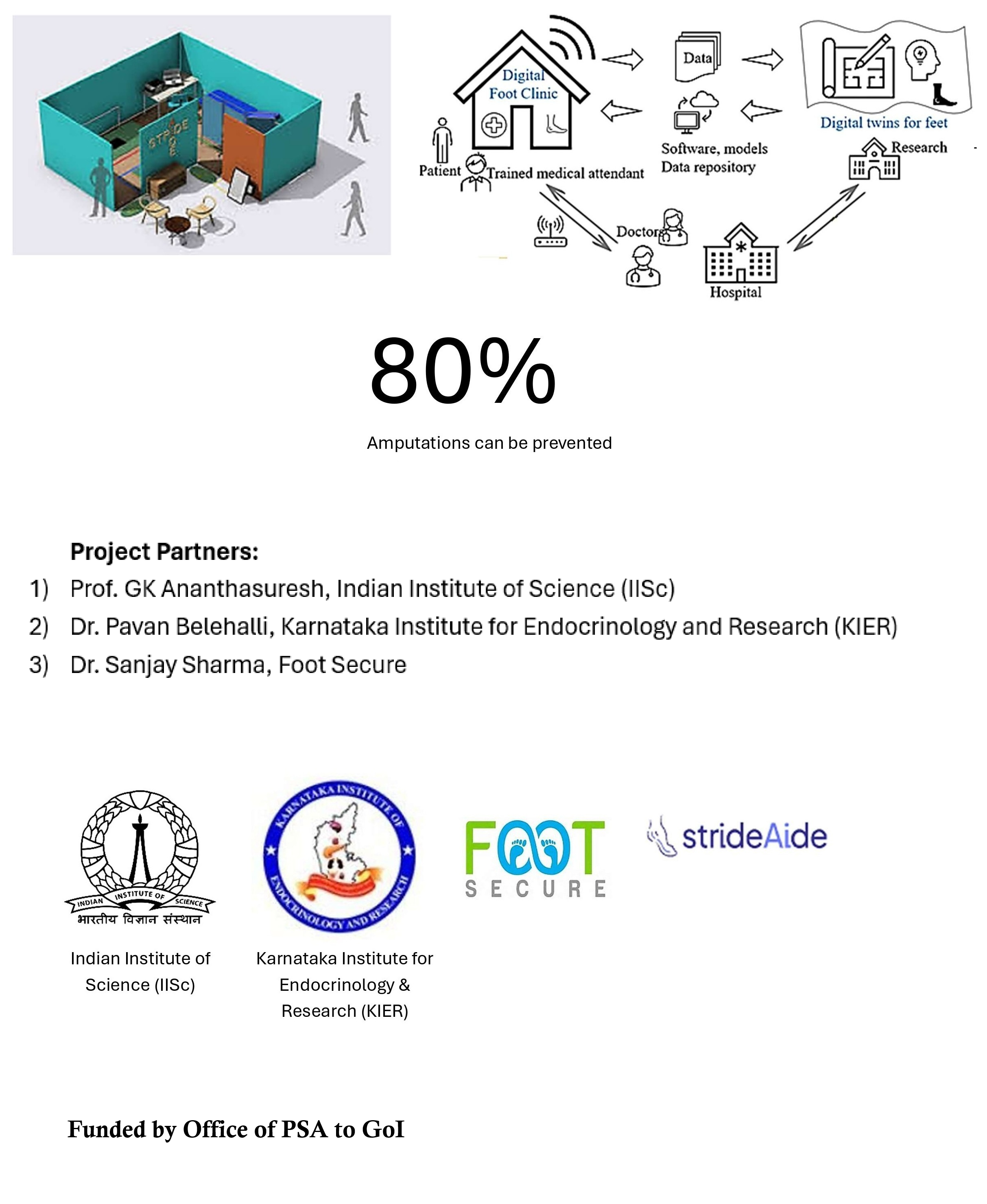
Digital Podiatry Clinic (DPoC)
Diabetes is a growing health crisis in India, with an alarming rise in cases over the past few decades. One of the most debilitating complications of this condition is the development of foot ulcers, which can lead to severe consequences if left untreated, including amputation and even mortality. Patients with diabetes are at a higher risk of foot disorders such as loss of sensation in the feet, reduced blood flow to the feet and foot deformities. As the country grapples with this challenge, BeST (Bengaluru Science and Technology) Cluster at the Indian Institute of Science enables a unique collaboration between academia (IISc & Karnataka Institute of Endocrinology and Research), start-ups (Foot Secure | StrideAIde), and the government (BBMP | MoHFW) and is paving the way for a unique effort called The Digital Podiatry Clinic (D-PoC) aimed at early screening and management of diabetic foot disorders.
D-PoC Benefits
The D-PoC is designed to be user-friendly and non-invasive. A patient entering a D-PoC will first fill in their details, such as their history of diabetes, duration of symptoms, and medication and so on in a trilingual hand-held device such as a tablet. This will help to build a diabetic foot registry for further research. The D-PoC consists of three devices connected to a dashboard and trained paramedical staff to assist the patient. The patient has to first walk on a pedo-scanner, which displays the pressure points of the foot. Then, the patient is assessed using ‘Neurotouch’, a small portable device that can identify the level of peripheral neuropathy. Following this, the patient undergoes Ankle Brachial Index (ABI) and Toe Brachial Index (TBI) tests to check for blood-flow obstructions in the foot. Based on the results of the three tests, the patients are informed how likely they are to get a diabetic foot complication and how often they would be required to undergo a foot evaluation. The aim is to create a digital twin for each patient, predicting their chances of developing complications over time and providing preventive podiatry treatment, including self-offloading footwear, like the customized footwear developed by the team.
Contact: mrinal.sarma@bestkc.in
Assessing the Impact of Yellow Line Mass Rapid Transit (MRT) system on Public Health and Quality of Life
Description
Despite the growing emphasis on public transport, a significant gap exists in understanding the comprehensive impacts of Mass Rapid Transit (MRT) systems, particularly on public health and overall quality of life. Existing studies often focus on singular aspects, such as emissions reduction or travel time savings, without integrating the broader dimensions of mental well-being, social inclusivity, and urban productivity. This study aims to bridge that gap by evaluating both objective metrics (e.g., changes in physical activity levels, exposure to pollutants, and accident risks) and subjective outcomes (e.g., commuter satisfaction and perceptions of social inclusivity). By addressing this gap, the research will provide policymakers and urban planners with actionable insights into how sustainable mobility systems can enhance urban living conditions. Furthermore, it positions the Yellow Line MRT not merely as a transportation project but as a catalyst for socio-economic transformation and public health improvement in Bengaluru.
Impact Goals
- Understanding connection between use of public transport and effect on human health
- Documenting the health outcomes such as physical activity changes
- Using this information to inform intersectoral approaches to health
- Informing the public policies which promote increased investment for public transport
- Bringing multiple stakeholders together to understand the connectedness and hence, need for more holistic planning
Key members
- Ashish Verma, IISc
- Prabhdeep Kaur, IISc
- Aruna Sivakumar, Imperial College London
Key organizations
- Indian Institute of Science
- Imperial College London
- ELCIA – Electronic City Industries Association
- Biocon
Funded by: Biocon Foundation, ELCIA – Electronic City Industries Association
Contact: nidhya.nadarajan@bestkc.in
BASF-BeST STEM Scholarship for Government School Students
Description
Foundation for Bengaluru Science & Technology in collaboration with BASF India is happy to introduce a catalytic STEM scholarship program to empower talented government school students with financial support and academic enrichment opportunities. The current call aims to support a total of 175 school students of class 8-10 from the schools located at Mangalore, Dahej and Navi Mumbai. Scholarship components include Basic needs, STEM DIY kits, Mentoring Sessions and Financial aid.
Impact Goals
- Improved academic performance
- Increased STEM engagement
- Enhanced confidence and aspirations
Key organizations
- BASF India
- Foundation for Science, Innovation and Development, IISc
- Science for Rural India
Funded by: BASF India
Contact: nidhya.nadarajan@bestkc.in
Industry-Academia Synergy Workshop Series
Description
Industry-Academia Synergy Workshop Series is a unique program designed by BeST for the faculty members of the institutions under DCTE, GoK, as part of the Avishkaara initiative of the Department of Higher Education, GoK which is a flagship program of the state to enhance the IP ecosystem of the Government Engineering Colleges, Polytechnics and First Grade Degree Colleges. Industry-academia synergy will enhance the quantity and quality of Intellectual Property (IP) produced within academic settings by providing access to real-world problems and emerging market needs, shared ecosystems, knowledge sharing, and improving the commercialization pathways. Each workshop brings together 25-30 faculty members and 3-5 industry experts in a specific theme and consists of panel discussions and brainstorming sessions to help identify industry-aligned research areas with IP potential and explore possible collaborative opportunities to enhance the synergies between industry and academic institutions.
Impact Goals
- Capacity Building in faculty members of state government institutions.
- Industry-inspired ideas with IP potential.
- Industry expectations in academia-industry collaboration.
Key organizations
- IPTel Indian Institute of Science
- Karnataka State Council for Science and Technology
Funded by: Directorate of Collegiate and Technical Education, Government of Karnataka
Contact: nidhya.nadarajan@bestkc.in